Kip Thorne's tremendous legacy to the realm of theoretical physics and astrophysics in the 20th century is practically second to none. Having trained a generation of scientists and made innumerable contributions to these fields, Kip Thorne is one of the best in his field and also one of the leading experts on the implications of Einstein's theory of general relativity.
Born in Logan, Utah in 1940 to a college professor father and chemist/economist mother, Thorne was raised in a highly academic environment and excelled in his schoolwork. Thorne's academic prowess allowed him to achieve his high educational goals at a relatively young age, receiving his BS at 22 from Caltech and his PhD from Princeton at 25. In 1967, Thorne returned to Caltech as one of the youngest full professors to teach theoretical physics. Throughout his many years of teaching at the institution, Thorne has mentored as many as 50 physicists who now work in the observational and experimental fields.
Overall, Kip Thorne's research has centered on astrophysics and gravitational physics, leading him to study such phenomena as relativistic stars, gravitational waves, and black holes. He is also credited with the somewhat controversial assertion that wormholes can be used for time travel. However, his contributions to the field largely concern Einstein's theory of general relativity, namely the general nature of space, time, and gravity.
Several of Thorne's discoveries are of great worth to astronomy. F0r example, Thorne proposed the idea of hoop conjecture, which describes the mechanism for black hole formation and also eliminates the view of a black hole as a naked singularity. Thorne along with his friend and colleague Stephen Hawking, believe that there is instead a singularity at the interior of the black hole.
Sunday, May 18, 2008

Friday, May 16, 2008
4.8 The M81 Galaxy Group
 In this deep field view, both bright galaxies and faint nebulae are visible. The largest visible galaxy is M81 and is in the center of the field of view. M81 is gravitationally interacting with M82 below it. M82 is an interesting galaxy due to its unusual halo of red gas. These galaxies are in the Virgo supercluster.
Friday, May 9, 2008
4.7 The Dark Tower in Scorpius
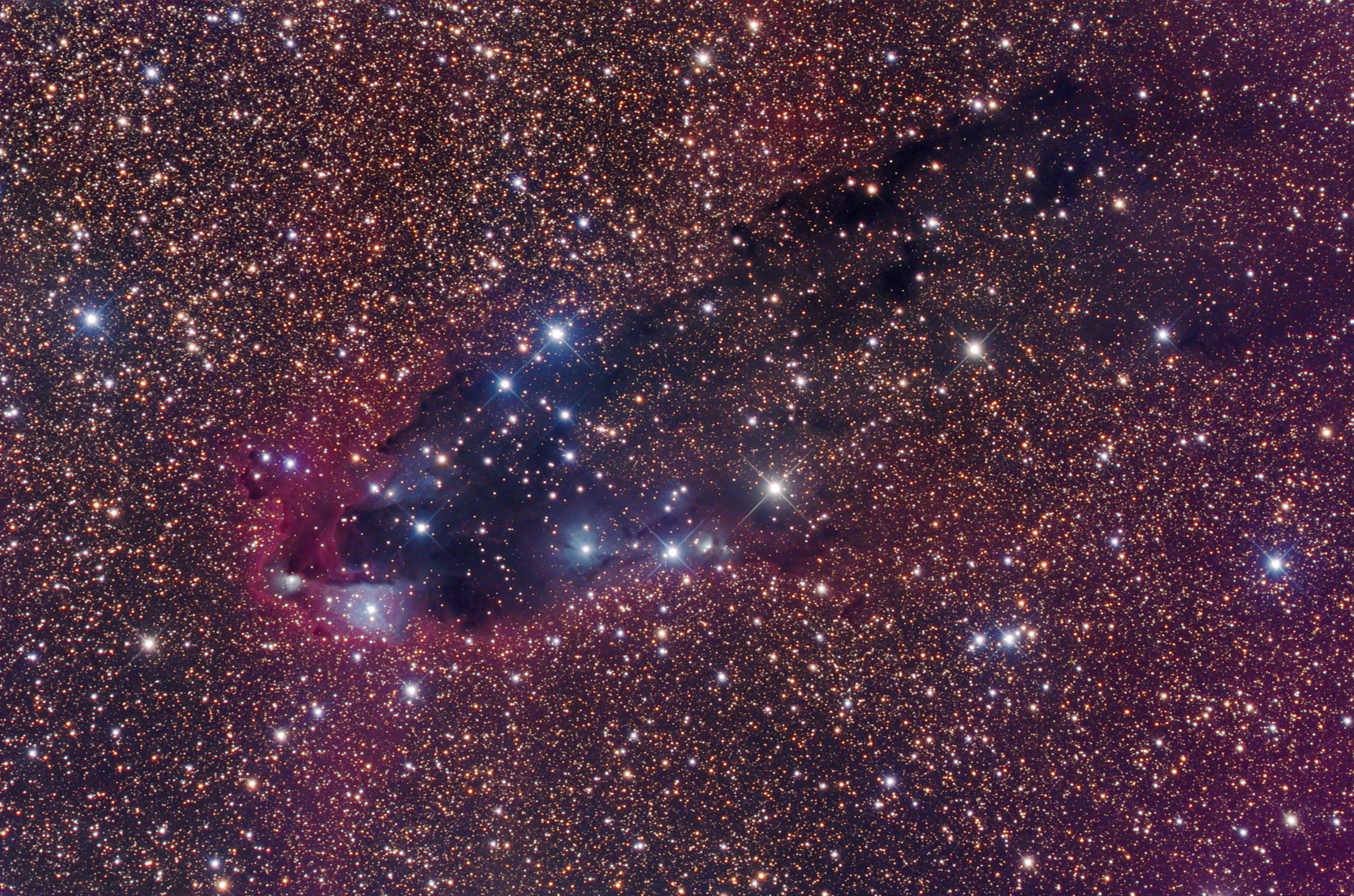 In this crowded starfield lies a dusty cosmic cloud nicknamed the "Dark Tower." Star formation is likely occurring in this dark nebula that is nearly 40 light-years across. This swept-back cloud is termed a cometary globule and is created by intense UV radiation from an OB association. This structure is about 5,000 light-years away.
Tuesday, May 6, 2008
4.6 Observation Log
Date: May 5, 2008
Time: 8;30-10:30
Location: 270 15' 29.35" N, 820 23' 44.36" W; My Home
Sky Conditions: Clear and great visibility after sunset.
Instruments: None (I forgot to come back and pick up binoculars)
Planets: Mars, Mercury
Bright Stars Noted: Capella, Castor, Pollux, Sirius, Procyon, Regulus, Spica, Arcturus, Betelgeuse
Constellations Noted: Hydra (Hydra's Head only), Gemini, Canis Major, Canis Minor, Ursa Minor, Auriga, Leo, Leo Minor, Corvus, Virgo, Bootes
Binary Stars: Capella (However, could not distinguish separate stars as no instruments were used)
Deep Sky Objects: Hyades, Pleiades
Asterisms: Winter Triangle, Hydra's Head, The Scythe, Big Dipper
Time: 8;30-10:30
Location: 270 15' 29.35" N, 820 23' 44.36" W; My Home
Sky Conditions: Clear and great visibility after sunset.
Instruments: None (I forgot to come back and pick up binoculars)
Planets: Mars, Mercury
Bright Stars Noted: Capella, Castor, Pollux, Sirius, Procyon, Regulus, Spica, Arcturus, Betelgeuse
Constellations Noted: Hydra (Hydra's Head only), Gemini, Canis Major, Canis Minor, Ursa Minor, Auriga, Leo, Leo Minor, Corvus, Virgo, Bootes
Binary Stars: Capella (However, could not distinguish separate stars as no instruments were used)
Deep Sky Objects: Hyades, Pleiades
Asterisms: Winter Triangle, Hydra's Head, The Scythe, Big Dipper
Sunday, May 4, 2008
4.5 Shaping NGC 6188
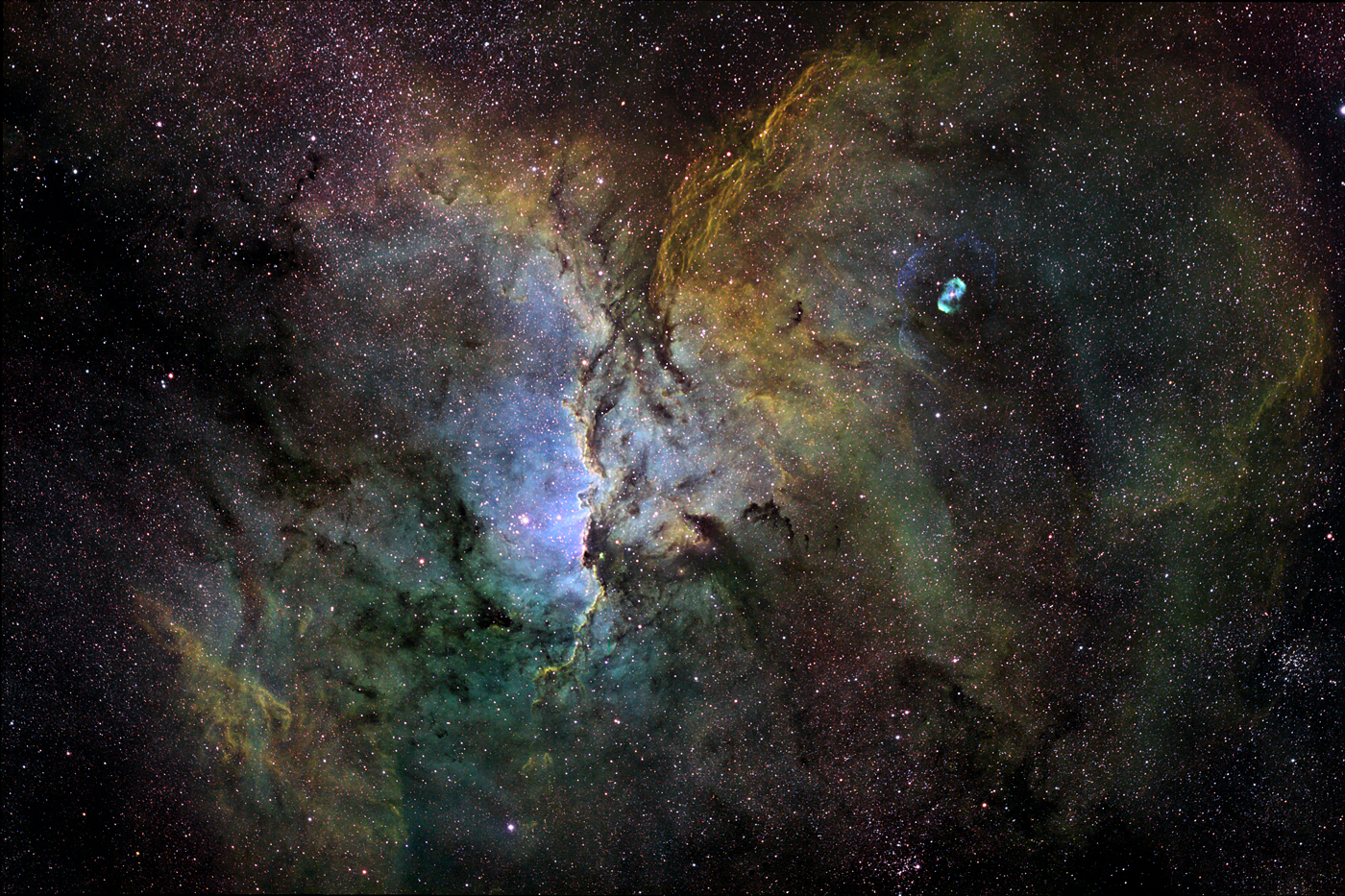 In the constellation Ara, NGC 6188 sits beside what is otherwise a large, dark molecular cloud. It is about 4,000 light-years away and very large as this image spans about 300 light-years. NGC 6188 is relatively young, having been formed only a few million years ago, and bright, young massive stars can be seen dotted throughout the image. The false coloring of this image shows the placement of certain elements such as oxygen, hydrogen, and sulfur.
4.4 M86 in the Virgo Cluster
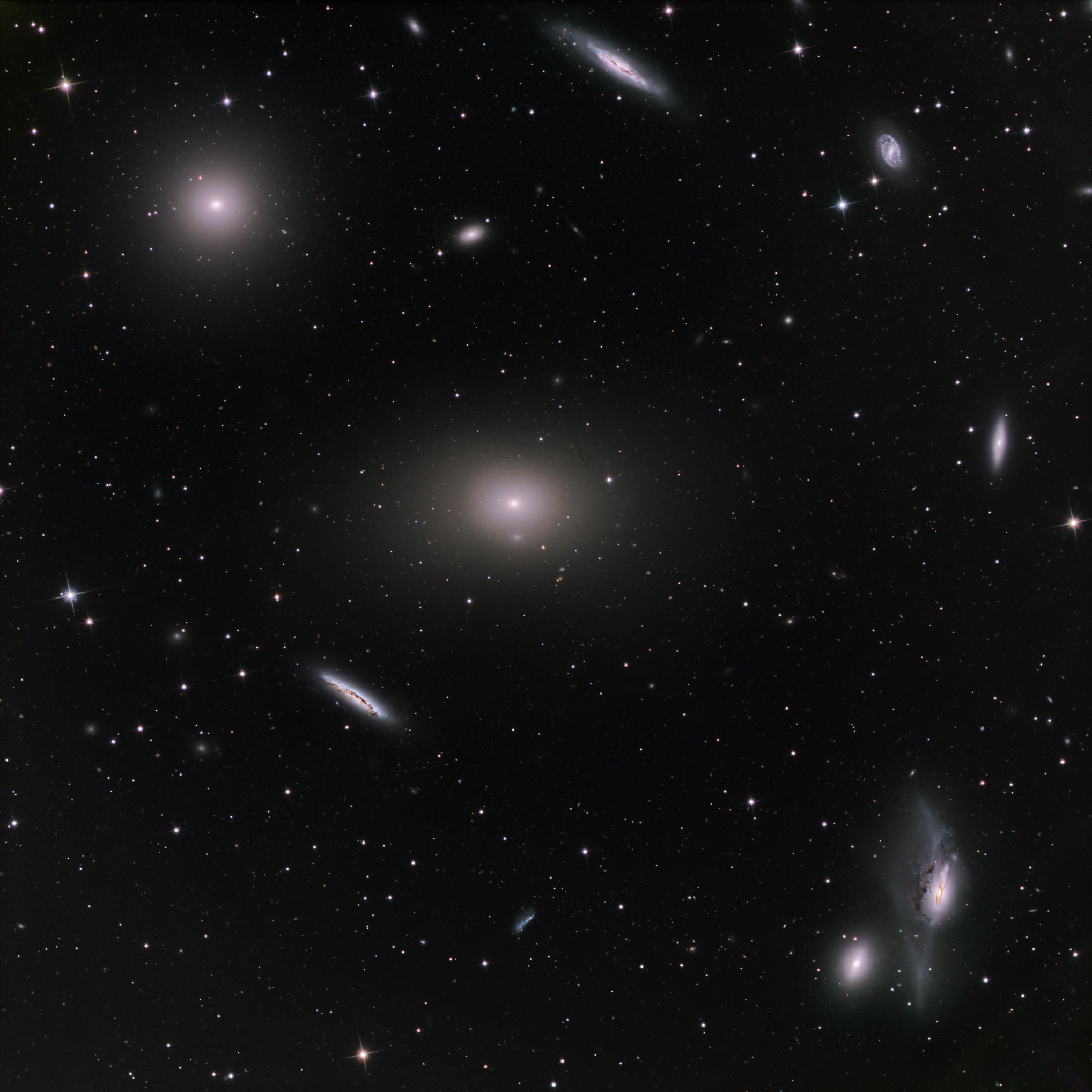 Near the center of this picture is M86, a bright galaxy in the Virgo Galaxy cluster. M84 is also visible in this photo as is a pair of interacting galaxies, Markarian's eyes. The Virgo Galaxy cluster is the closest large galaxy cluster, with well over 1,000 members. The cluster is about 50 million light-years away and covers nearly 10 degrees on the sky.
4.3 Messier 63: The Sunflower Galaxy
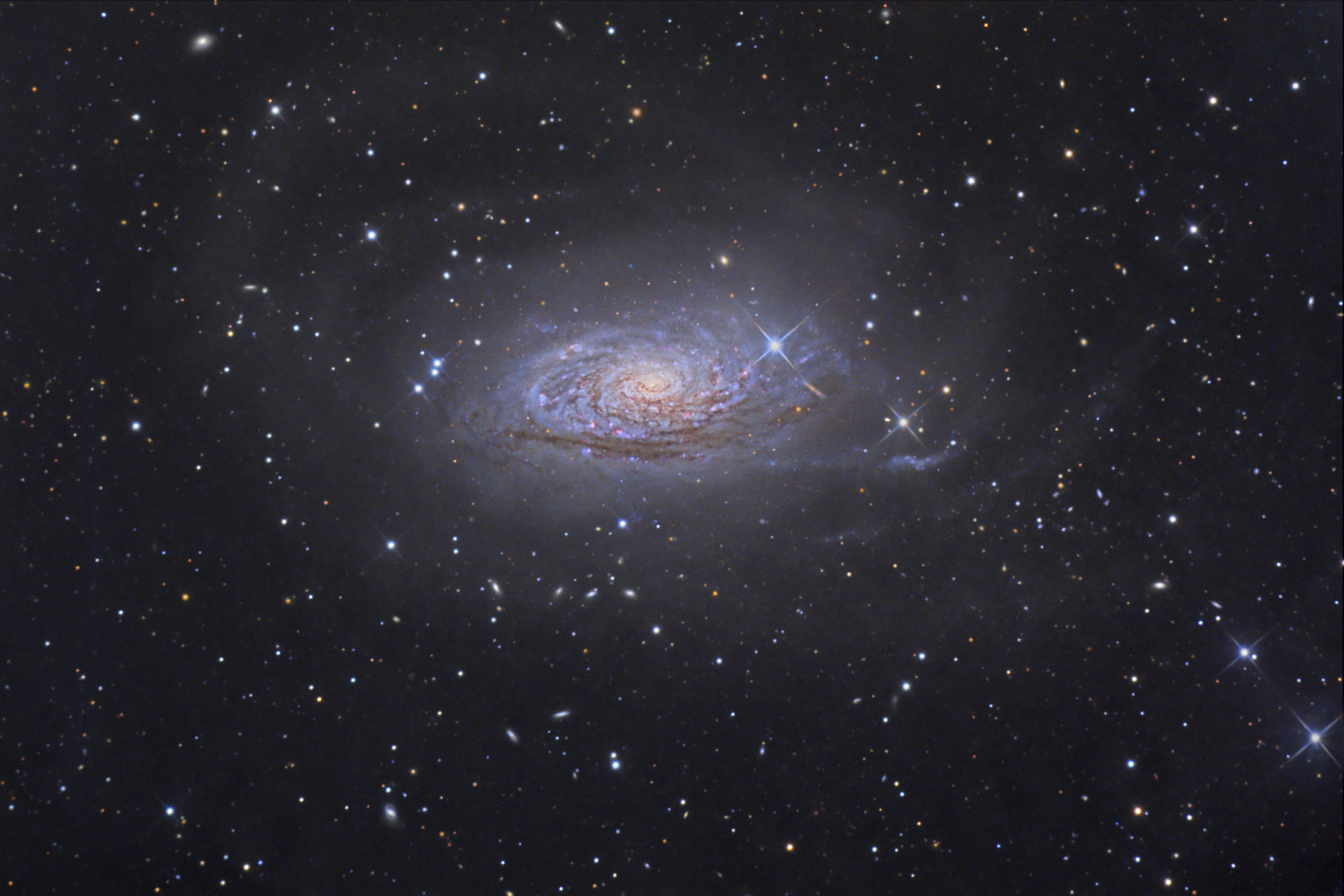 Deep in the Northern Sky, the Sunflower Galaxy is about 25 million light-years away in the constellation Canes Venatici, or the Hunting Dogs. It has a bright yellowish core and blue spiral arms and is dotted with pink regions of star formation. It is about the size of the Milky Way Galaxy. Extended features can be seen in this photograph, which are a result of the gravitational interactions between M63 and other galaxies.
Friday, April 11, 2008
4.2 Stickney Crater
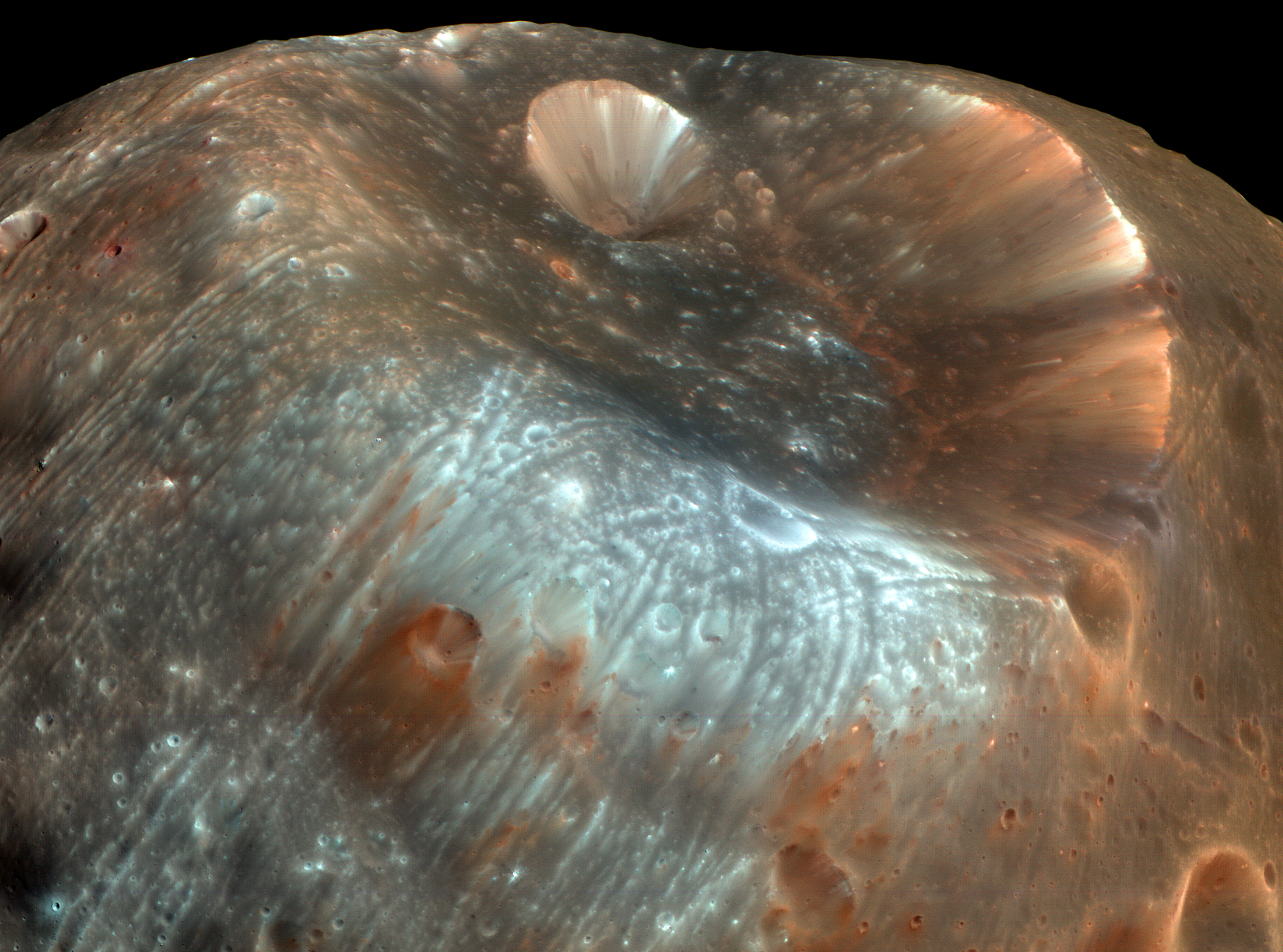 The Stickney Crater is the largest crater on the Martian Moon Phobos. Stickney is nearly half the diameter of the moon itself. The event that caused this crater seems to have almost destroyed the small moon. This image was taken by the HiRISE camera aboard the Mars Reconnaissance Orbiter. The streaks along Phobos suggest that material has slid inside the crater walls over time. The actual event that caused this crater is unknown.
Wednesday, April 9, 2008
4.1 The N44 Complex
 The N44 complex is about 1,000 light-years across and is a grouping of several emission nebulae. It can only be seen in the Southern hemisphere, located in Large Magellanic cloud, our neighboring galaxy. The stellar winds and heat given off from highly luminous stars sculpt the glowing nebular gas into unique shapes. Supernovae have also contributed to the complex's unique shape.
Friday, March 14, 2008
3.18 Sculpting the South Pillar
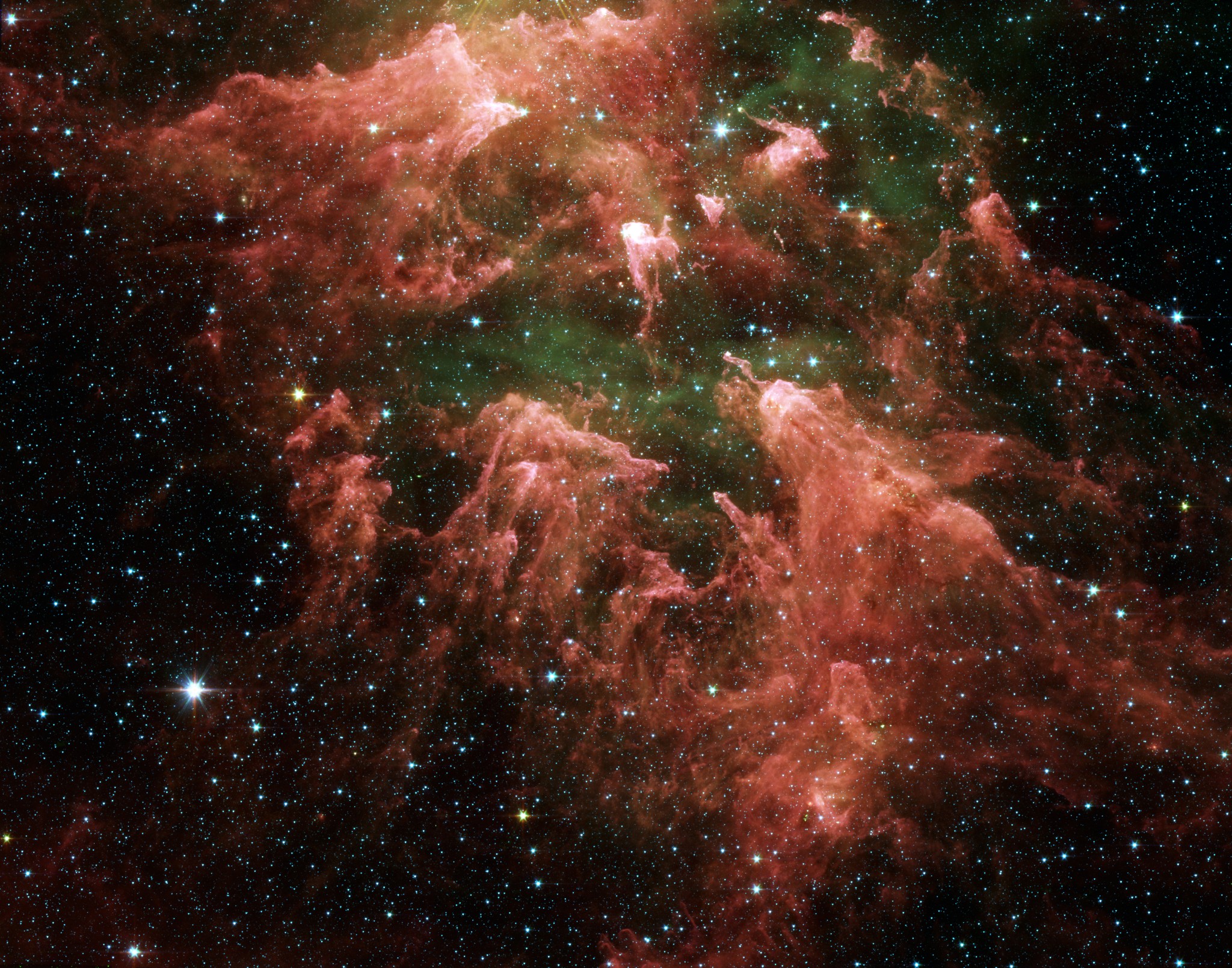 Eta Carinae, an unstable and massive star in the Milky Way, greatly affects its environment. This picture shows the South Pillar of the Carina Nebula, where regions of dust and gas are being molded by the intense wind and radiation of Eta Carinae and newborn stars. This region is nearly 10,000 light-years. This image was taken by the Space Spitzer Telescope and the image spans 200 light-years.
Thursday, March 13, 2008
3.17 Planetary Nebulae
http://www.williams.edu/astronomy/Course-Pages/111/Images/HST_PNe.jpg
http://www.cynical-c.com/archives/bloggraphics/eskimo.jpg
http://cseligman.com/text/stars/egg.jpg
http://home.att.net/~a.campanella/hubble_nebula_0828_f.jpg
http://science.nationalgeographic.com/staticfiles/NGS/Shared/StaticFiles
/Science/Images/Content/supernova-chaos-remnant-n-63a-sw.jpg
This is a Black Hole, for good measure:
http://science.nationalgeographic.com/staticfiles/NGS/Shared/StaticFiles
/Science/Images/Content/perseus-black-hole-perseus-sw.jpg
http://www.cynical-c.com/archives/bloggraphics/eskimo.jpg
http://cseligman.com/text/stars/egg.jpg
http://home.att.net/~a.campanella/hubble_nebula_0828_f.jpg
http://science.nationalgeographic.com/staticfiles/NGS/Shared/StaticFiles
/Science/Images/Content/supernova-chaos-remnant-n-63a-sw.jpg
This is a Black Hole, for good measure:
http://science.nationalgeographic.com/staticfiles/NGS/Shared/StaticFiles
/Science/Images/Content/perseus-black-hole-perseus-sw.jpg
Friday, March 7, 2008
3.16 The Cat Paw Nebula
 Visible in Scorpius, the Cat Paw Nebula is an impressive emission nebula. Its red color originates from an abundance of ionized Hydrogen. The nebula is nearly 5,500 light-years away. In the past million years, stars have been formed that are nearly a million times larger than the Sun. The Cat Paw Nebula is alternatively known as the Bear Claw Nebula as well as NGC 6334. This photo is an image of the end of the Cat Paw Nebula taken from a telescope in Chile.
Thursday, March 6, 2008
3.15 Pictures for Biography

Pickering in the year he began teaching at Harvard
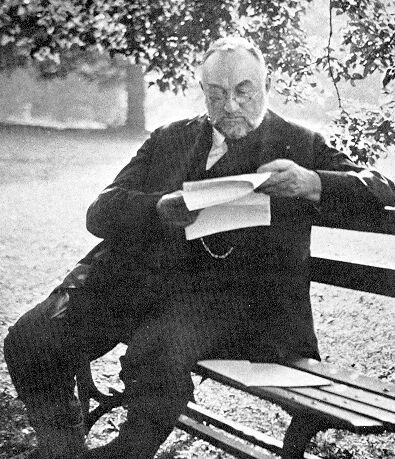
Pickering at Harvard

"Pickering's Harem"
3.14 Edward Pickering Biography
Edward Charles Pickering
Edward Charles Pickering was an American astronomer and physicist who indelibly left a lasting mark on both fields both in the United States and abroad. Pickering was born on July 19, 1946 in Boston, Massachusetts where he spent nearly all of his childhood. He attended Boston Latin School and then went on to receive his B.S. degree at Harvard University, graduating in 1865. In 1867, Pickering became a professor at the Massachusetts Institute of Technology (MIT) and held that position for ten years. At MIT, Pickering helped to establish the first U.S. laboratory in which student were required to use laboratory instruments to make measurements. Pickering left MIT to become the professor of astronomy at Harvard as well as the director of the Harvard observatory. That same year he co-founded the Appalachian Mountain Club, one of the United States’ oldest outdoor groups. Pickering was the director of the observatory for forty-two years during which time he and his staff observed more than forty-five thousand stars. The observatory under his direction was also able to make great leaps in the gathering of stellar spectra by means of photography. Pickering was also able to hire several women in his observatory due to several donations from Henry Draper’s widow. They included Annie Jump Cannon, Henrietta S. Leavitt, Williamina P. Fleming, and Antonia Maury. These women became popularly known in the scientific community as “Pickering’s Harem.” Despite this nickname, many of these women made important discoveries in the field. The observatory also produced the Henry Draper Catalogue, which contained objective prism spectra from nearly a million stars according to Annie J. Cannon’s “Harvard Sequence.”
Pickering also introduced the use of the meridian photometer to the observatory, which utilized a calcite prism to juxtapose the image of a star with one of a designated group of north polar stars to compare their brightness. Much of the data collected from this device was used to compile another catalogue entitled Harvard Photometry. He also established an observatory in Arequipa, Peru in 1891, where he collected data of southern stars that he combined with the data collected in Massachusetts. From this data, he published the first all-sky photographic map. Pickering and Hermann Carl Vogel both independently discovered the first spectroscopic binary stars. In addition, Pickering discovered a new series of spectral lines that were actually due to ionized Helium. In 1911, Pickering also co-founded the American Association of Variable Star Observers with William Olcott, where he encouraged many amateur astronomers. Edward Pickering died at Harvard on February 3rd, 1919. Pickering also won several awards during his lifetime. These include the Bruce Medal, the Royal Astronomical Society’s Gold Medal, the Henry Draper Medal, and the Order Pour le Merite for Arts and Sciences. Furthermore, Pickering held several leadership positions in his field, including President of the American Astronomical Society and the American Association for the Advancement of Science. Because of Pickering’s contributions to Astronomy, many objects are named for him. The Pickering crater on the Moon is named both for him and his brother William Pickering. There is also a Pickering crate on Mars in his honor as well as minor planet 784, Pickeringia.
Sources were previously listed.
Friday, February 29, 2008
3.13 The Eagle Nebula
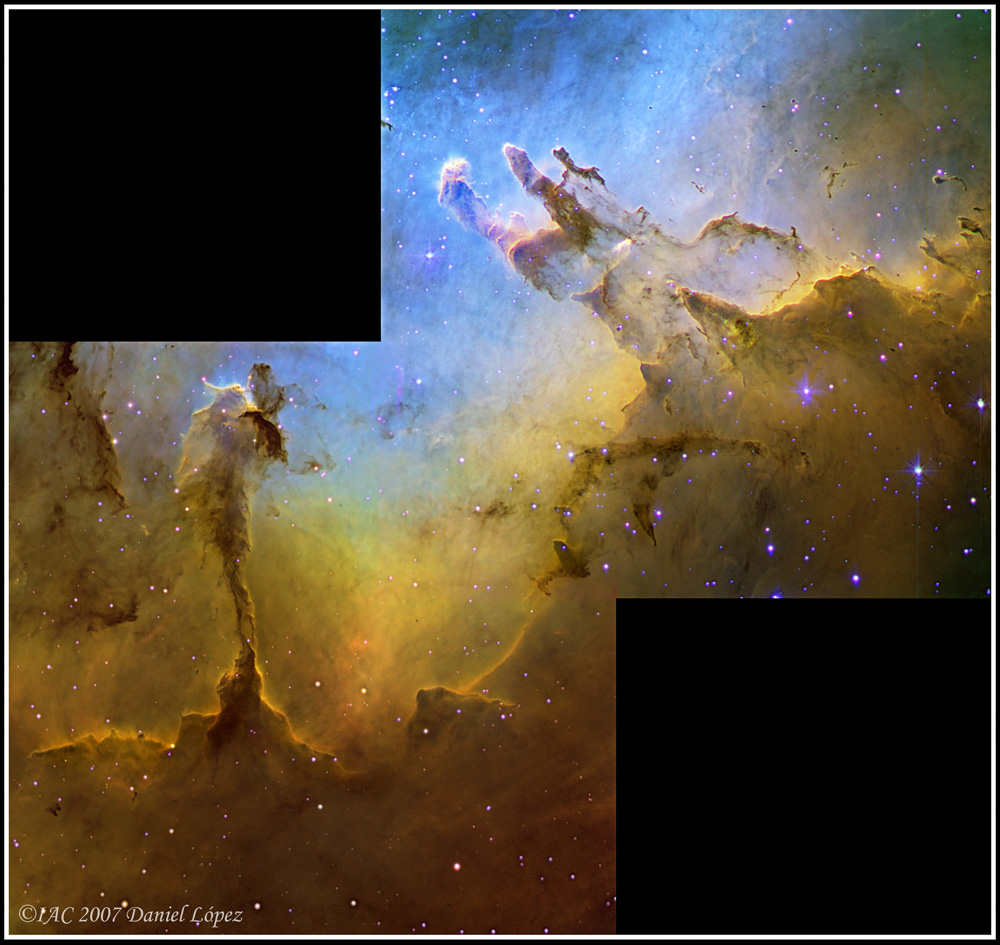 The pillars of the Eagle Nebula, bright stars are still forming in this well-known image taken by the Hubble Space Telescope in 1995. The light taken in was emitted only from Hydrogen, Sulfur, and Silicon, contributing to the high resolution of this image. These bright stars have been continually forming for nearly 5 million years. The nebula, also known as M16, spans nearly 20 light-years and can be viewed near the constellation Serpens.
Thursday, February 28, 2008
3.11 Pickering Biography Sources
Works Cited
Bailey, Solon I. The History and Work of Harvard Observatory, 1839 to 1927. New York: McGraw-Hill, 1931. Internet Archive. 28 Feb. 2008 [http://www.openlibrary.org/details/historyandworkof031439mbp].
Plotkin, Howard. "Edward C. Pickering and the Endowment of Scientific Research in America, 1877-1918." Isis 69 (1978): 44-57. JSTOR. 28 Feb. 2008 [http://links.jstor.org/sici?sici=0021- 1753%28197803%2969%3A1%3C44%3AECPATE%3E2.0.CO%3B2-8].
Tenn, Joseph S. "Edward Charles Pickering." The Bruce Medalists. 11 Feb. 2006. Sonoma State University. 28 Feb. 2008 [http://www.phys-astro.sonoma.edu/BruceMedalists/Pickering/index. html].
3.10 Nebula Videos and Images

The Ant Nebula
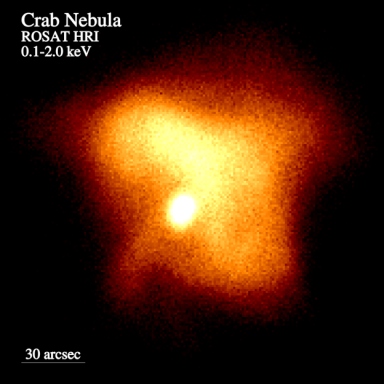
HRI image of Crab Nebula

Hubble Image of Crab Nebula showing Variations in Density
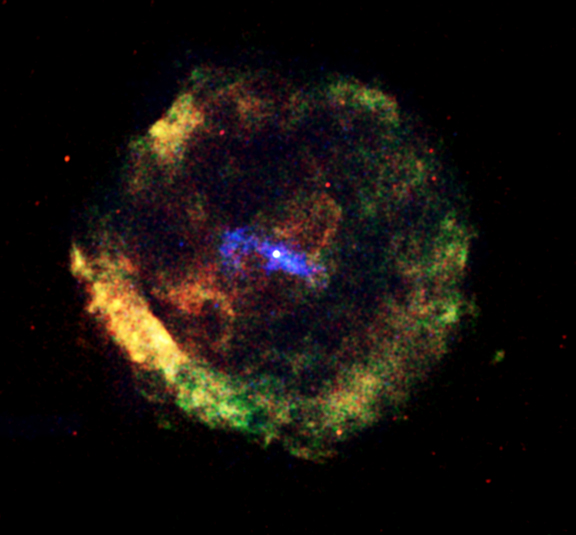
Chandra Image of Cigar Nebula
3.9 Young Stars in the Rho Ophiuchi Cloud
 Taken by the Spitzer Space Telescope, this image shows cosmic dust clouds and embedded newborn stars in false color. This image is part of the Rho Ophiuchi cloud complex some 400 light-years away, one of the closest star forming regions to Earth. The large cloud of cool Hydrogen is heated by these new stars, causing it to glow in the infrared. This image spans about 5 light-years.
Wednesday, February 13, 2008
3.8 Apparent Magnitude Worksheet
Apparent Magnitude Worksheet
- Eta Aurigae 3.5
- Beta Eridani 3.9
- Gamma Orionis 2.4
- Beta Tauri 3.1
- Delta Orionis 2.1
- Zeta Orionis 2.0
- Mu Geminorum 2.8
- Xi Geminorum 3.7
- Sigma Canis Majorum 4.4
- Eta Canis Majorum 1.9
- Alpha Geminorum (Castor) 1.0
Subscribe to:
Posts (Atom)